Showing posts with label start up. Show all posts

Wednesday, January 05, 2011

Accounting for software costs

An interesting question when it comes to accounting and software development is, whether a particular activity that is involved in the creation of a software can be categorized as a “Capital Cost” or an “Expense”. Below are links to some of the accounting standards that I found online.

I am no accountant, but it looks like typically all activities surrounding the creation of a software are typically recorded as capital costs (as long as the software has a useful life of 2 years or more) and all activities surrounding its maintenance are recorded as expenses.

According to an article in CFO.com: (link below)
Current Financial Accounting Standards Board guidelines require that all costs incurred before a product reaches "technological feasibility" — the point at which it can actually be produced — must be treated as R&D expenses. After that, companies can capitalize costs associated with software development until the product is released. Once that happens, the capital expenses are amortized.

An interesting thing about the above statement is, how do you account for software that is being produced using an Agile methodology? Software applications that are developed using an Agile methodology can be in continuous development through-out its life and also at the same time be in production (achieving technological feasibility early in its life).

Links:
Accounting for Internal Use Software (Federal Financial Accounting Standards): http://www.fasab.gov/pdffiles/fasab10.pdf

Accounting for Software Costs, Computer Systems and Business Process Reengineering (Yale University): http://www.yale.edu/ppdev/policy/4203/4203.pdf

Accounting for the development costs of internal-use software: http://www.allbusiness.com/accounting-reporting/assets/196287-1.html

Software Expensing Grows, Study finds (CFO.com, an interesting article that was released recently): http://www.cfo.com/article.cfm/14545408

Definition:

Capital costs: Costs that have an estimable future benefit which are included on the Statement of Financial Position as assets,
and amortized or depreciated over their estimated useful lives.
Expenses: Costs that do not provide future benefit and are recorded directly on the Statement of Activities in the period in
which the costs are incurred.

Thursday, March 11, 2010

What’s A Startup? First Principles.

What’s A Startup? First Principles. 

a startup is an organization formed to search for a repeatable and scalable business model.

A good post by Steve Blank on what a Business Model is and other good stuff that any business person should be cognizant of.

How Does Customer Development, Agile Development and Lean Startups Fit?
The Customer Development process is the way startups quickly iterate and test each element of their business model. Agile Development is the way startups quickly iterate their product as they learn. A Lean Startup is Eric Ries’s description of the intersection of Customer Development, Agile Development and if available, open platforms and open source. (This methodology does for startups what the Toyota Lean Production System did for cars.)

http://steveblank.com/2010/01/25/whats-a-startup-first-principles/

Sunday, January 04, 2009

Earn $100 and help a local startup

Via ColoradoStartups.com

image SurveyGizmo is looking for people with a relative degree of computer experience and are comfortable doing online search and navigating websites in a browser, to participate in a usability study in Boulder. Participants will need to come to their Boulder office on January 20th or 21st for approximately 60-90 minutes to be observed using the software.

The company is offering a $100.00 American Express gift card upon completion of the study.

If you are interested in helping out SurveyGizmo and getting $100, just follow this link.

Saturday, December 13, 2008

Vesting

Here is a good article on vesting (and how it is typically setup for new companies that are in the process of getting funding from VCs, etc.)

http://www.feld.com/blog/archives/2005/05/term_sheet_-_ve.html

Tuesday, November 11, 2008

Is that a nuclear power plant in your backyard?

A company called Hyperion is taking technology developed at the Los Alamos labs and creating a small, self contained, nuclear power plant. These power plants are about as wide as a “bath-tub” (according to the website) and a little taller than a person.
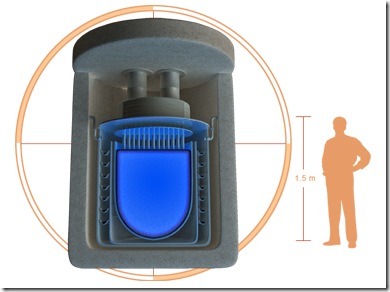
feature_image

These self contained power-plants fueled with a small amount of non-weapons grade radioactive material can provide electricity to 20,000 homes (25 Mwe). As these reactors have no moving parts, they are made to be placed in places that do not need constant access (think buried under ground), making them safe from unwanted human access (think bad people). Even if somebody were to try to get access to the radioactive material inside the reactor because it is non-weapons grade they could not be used to do bad things (like creating a bomb). These reactors are sealed at the factory and once sealed they are designed to never be opened again, making it easy to install and operate.

Worried about a melt-down are you? No worries here, the technology used by these reactors makes it so that if the reactor were to go into an uncontrolled reaction then upon exposure the core will cool down immediately. Also because the reactors are made to be buried in the ground, any leaked radiation would be absorbed before becoming dangerous to humans.

water-blue

The cost…. a cool $25 million for the first generation reactors. These reactors are not made for individual homes but for cities. If pure electricity driven cars become a reality and popular then such reactors would be able to provide the electricity needed to power these cars. As they will be close to a city, they would cut down on the energy loss typically seen with power transmission from far away located power generation stations.

Finally, these units can be deployed to far away places (Artic science stations, remote communities and poor villages in places like Africa).

Read more about the technology from Dr. Pete’s LANL page - http://pearl1.lanl.gov/external/Research/peterson_FLC.html

02-037-reactor

Lots more information about the technology and company is available from their FAQ page:

http://www.hyperionpowergeneration.com/about_FAQ.html

What is Hyperion?
The Hyperion power reactor is a compact, self-regulating power module (also referred to as a battery or power drive) that complements existing nuclear reactors by filling a niche for moderately sized, distributed, or dedicated power applications

What role does Los Alamos National Laboratory (LANL) have in the development of Hyperion?
Hyperion was invented by award-winning LANL scientist Dr. Otis Peterson while he was employed full-time by the lab. Under the Technology Transfer program for U.S. national laboratories, LANL will continue to own intellectual property relating to the Hyperion technology, but the rights to commercialization (introduction, manufacturing, licensing, production, marketing, and sales) of the product resulting from Dr. Peterson’s invention are held by Hyperion Power Generation, Inc., (HPG) a Santa Fe, New Mexico-based corporation. HPG is paying for the license to the rights to the intellectual property known as Hyperion (aka Comstar). HPG is also funding further research and engineering of the technology for Hyperion at LANL.

Who invented Hyperion?
Otis G. (Pete) Peterson, Ph.D. invented the self-regulating, inherently safe nuclear battery (reactor) during his tenure at Los Alamos National Laboratory (LANL). In addition to designing the Hyperion reactor and co-inventing a biomass to fuel conversion process, his technical expertise has focused on wavelength tunable lasers, solid-state physics, and international science issues.

Among his many career accomplishments, Dr. Peterson holds six patents including those for his inventions of the cw Dye Laser and Alexandrite Laser, which earned R&D 100 awards. In the 1990’s he served as science attaché at the American Embassy in London for environmental preservation and non-proliferation issues. He has served as a group leader at LANL and in management positions at Eastman Kodak and Allied Chemical, where he co-founded the laser-induced chemistry program. He is also the co-founder of the laser isotope separation program (AVLIS) at Lawrence Livermore Laboratory in 1973, which continued for 26 years.

Honored with numerous awards and published widely, Dr. Peterson is a fellow of the Optical Society of America and his career publications have been cited over 1,200 times in technical literature. He was awarded his doctorate in Solid State Physics from the University of Illinois. Dr. Peterson is now the Chief Scientist for HPG. He has retired from full-time work at the lab.

Will Hyperion be secure?
The power-producing core of this module will be contained within multiple gas-tight chambers to insure absolute containment of all gases, along wth other contaminants in the unlikely event that a single chamber fails. Further, the module will be buried in the ground during its operational life. This will protect the module from almost all conceivable threats, natural or man-made, and make tampering extremely difficult. Additionally, active area security will be provided by the operator.

How does Hyperion work?
Unlike conventional designs, the proposed reactor is self-regulating through the inherent properties of uranium hydride, which serves as a combination fuel and moderator. The temperature-driven mobility of the hydrogen contained in the hydride controls the nuclear activity. If the core temperature increases over the set point, the hydrogen is driven out of the core, the moderation drops, and the power production decreases. If the temperature drops, the hydrogen returns and the process is reversed. Thus the design is inherently fail-safe and will require minimal human oversight. The compact nature and inherent safety open the possibility for low-cost mass production and operation of the reactors.

Who is currently funding the development of Hyperion?
The Hyperion project has been funded thus far by Denver-based Altira Group, one of the nation’s premier venture capital funds focused on alternative energy technologies, and by private individual investors.

Who is building the HPG company?
Santa Fe-based Purple Mountain Ventures, Inc. is supplying management services and personnel for Hyperion Power Generation.

Saturday, October 04, 2008

20 tips on how to start a start-up

20 tips on starting a Start-Up, presented by Andy McLoughlin who started Huddle.net as gathered by Zack Whittaker (Student Technology Day: how to start a start-up | iGeneration | ZDNet.com)

  • Take advantage of every connection possible. Regardless of how tenuous they may be, you’ll know a lot of people and they’ll all be able to help on one level or another.
  • Be ruthless when doing deals; even at the very beginning. If you let people walk all over you, you’ll set a precedent from that point on and people will start taking advantage from a very early start.
  • Design, build, then test and carry on with that cycle. Once a feature works, carry on with the development cycle and don’t stop or deviate until you’re ready to present the world with a product at very least beta stage.
  • Be completely and utterly uncompromising in your vision. People may end up hating you because you won’t deviate from your goal but it’ll all be worth it in the end.
  • Go big or go home. If you can’t convince even yourself that your product isn’t good enough, then you won’t be able to convince others.
  • The way to a rich man’s wallet is through his PA. If you can, get out a copy from the library, of “The Beermat Entrepreneur“.
  • Software is expensive, but it doesn’t have to be. With DreamSpark and the MSDN Academic Alliance programs which are often supported by your university or college, this makes getting hold of expensive software easier - and for free. Don’t forget, a lot is open-source as well - and by definition, open-source is free.
  • Focus all your energy on getting the product great. Marketing, press and public relations can wait as they come later on. Once you’ve got a brilliant product, that’s when you can start showing it off to the world.
  • Get out there! Meet up’s and events, conferences and parties are a great way to meet influential people, often those with huge amounts of cash. By meeting these people will help you get more innovative ideas and also make connections.
  • Successful companies don’t have to work in Silicon Valley, although it does help. Huddle.net are based in London and are more than happy with that; nevertheless, going out there to Silicon Valley and meeting more people is an important part of keeping relationships going with different people and other companies.
  • Funding gives you a little bit of breathing space. Once you get funding through from investors, that’s the time to get the staff just right. Sure, it’ll mean firing people but it also means getting to hire the best of the best.
  • You can’t do all of this by yourself! Seriously, if you did then you’ll end up going potty. What do you think CEO’s, CTO’s and CIO’s are for? Spread the load, spread the work.
  • Being acquired by someone isn’t a business model. If you tell your investors your main goal is to be acquired, they’ll lose faith. Just avoid doing it.
  • You’ll always have more ideas than the capacity to make them happen. Sure, having inspiration and understanding is important, but you’ll have a ton of things you’ll want to include and integrate, but you can’t always make them happen straight away. Give yourself time and a plan for future releases.
  • Make the company feel like a family. Why do you think Google and Facebook are doing so well? Having a “family” as a workplace makes happier employees, therefore better employees. Invite friends, family, siblings and spouses along to events - get them part of the family too.
  • Keep an eye on the web, because that’s where a lot of your inspiration will come from. Mashable, Technorati, Twitter and Techmeme are great sources for information and more importantly, inspiration.
  • Never lose sight of what you’re doing. If you do, you won’t survive.

Sunday, September 28, 2008

Boulder Needs More Kickass Developers

image

Want a FREE trip to beautiful Boulder, Colorado? The Boulder tech scene is growing like crazy. Twenty of our top tech startups have banded together to fly in one hundred top software developers, programmers and engineers from across the country, all expenses paid. You can apply to be one of the hundred.

Boulder Colorado Job Fair » Boulder Needs More Kickass Developers

Sunday, September 21, 2008

Thursday, September 11, 2008

DropBox - the coolest way to keep files synced

Came across DropBox today. It is probably the coolest new tool that helps you keep files synchronized between all your computers. image

I have been using Live SkyDrive and that is (was) a great way to store and share files. The only problem is that there is no desktop interface. It is a purely web-based tool.

To keep my laptop and desktop machine synched, I use SyncToy 2.0. That tool works great as long as the machines you want to keep synched are on the same network. (And because it works on the home network - it is very fast in synchronizing gigabytes worth of files).

DropBox - I don't think would work well to synchronize entire drives of data. But here are some very, very cool features that I don't think are available in any other software at this point.

1. A public folder is provided into which you can drop files and then choose to share them with anyone through a web address. (Here is a sample file shared in the public folder:http://dl.getdropbox.com/u/129620/gis_day_2006.jpg)

image Files in the Public folder can be shared by copying the public url from the context menu.

2. It is extremely easy to create a shared photo gallery. All you need to do is create a folder under the Photos folder and drop your images into it.

image Folders under the Photos folder - which automatically become shared photo galleries.

(Check out this example that I have shared: http://www.getdropbox.com/gallery/129620/1/DropBoxSamples?h=2a1e54)

3. While it might look like you are giving people access to your drive via the Public and Photos folders, what is happening in reality is that DropBox is copying your files onto their servers, and people are downloading the files from these servers.

4. Another awesome feature available is the ability to undelete files from the drop-box folder. Because the files are stored on a server, even when you delete a file on a local drive - you still have the ability to go to the web interface and undelete these files. The minute you un-delete a file - it immediately pops up into the drop box folder.

5. It is fast!. I shared a file on one of my machines and it was almost immediately available on my other machine's DropBox folder.

If my post did not sell you on DropBox - then take a look at the screencast at http://www.getdropbox.com/#. It shows you all the cool features available in DropBox.


Currently DropBox is in public Beta. You get 2gb of space with the free account.

If by the time you get this email - the beta gets closed - leave me a comment with your email address and I will send you an invite. (I got 10 invites to give away - available to all those who register).

I wonder if this app might become the next Napster - as it makes it sooo easy to share files with other users. (And I wonder if there is anything in the EULA that prohibits users from doing so).

Sunday, June 15, 2008

Cam-Trax - Controller based on Video Tracking

A while back I had written about the real cool demos that Johnny Chung had made taking the Wii controller to the next level - by using it to track different kinds of objects so as to be able to work as a input device. (Johnny Chung Lee - Projects - Wii). The idea was based on using the camera in the Wii Remote to track objects (basically using the remote in a reverse configuration than the way it was intended to be used).

The following video is from what looks like an Israeli company - that has taken video tracking to the next level - by allowing you to use almost any object as an input interface. Check out the video as words are hard to describe the coolness of what these guys have done.


I love how they have mixed up Pong and brought that game in to the 21st century. Cant wait to play it. Wonder if Nintendo will buy this technology to incorporate it into the Wii.

Thursday, January 10, 2008

Top Ten Myths of Entrepreneurship

A good article from Guy Kawasaki's blog about the top ten myths about entrepreneurship.

From How to Change the World: Top Ten Myths of Entrepreneurship
This post was written by Scott Shane as a follow up to his entrepreneurship test.

I have highlighted the portions that I think are the important take away points for each of the myths.

  1. It takes a lot of money to finance a new business. Not true. The typical start-up only 1 requires about $25,000 to get going. The successful entrepreneurs who don’t believe the myth design their businesses to work with little cash. They borrow instead of paying for things. They rent instead of buy. And they turn fixed costs into variable costs by, say, paying people commissions instead of salaries.

  2. Venture capitalists are a good place to go for start-up money. Not unless you start a computer or biotech company. Computer hardware and software, semiconductors, communication, and biotechnology account for 81 percent of all venture capital dollars, and seventy-two percent of the companies that got VC money over the past fifteen or so years. VCs only fund about 3,000 companies per year and only about one quarter of those companies are in the seed or start-up stage. In fact, the odds that a start-up company will get VC money are about one in 4,000. That’s worse than the odds that you will die from a fall in the shower.

  3. Most business angels are rich. If rich means being an accredited investor –a person with a 2 net worth of more than $1 million or an annual income of $200,000 per year if single and $300,000 if married – then the answer is “no.” Almost three quarters of the people who provide capital to fund the start-ups of other people who are not friends, neighbors, co-workers, or family don’t meet SEC accreditation requirements. In fact, thirty-two percent have a household income of $40,000 per year or less and seventeen percent have a negative net worth.

  4. Start-ups can’t be financed with debt. Actually, debt is more common than equity. According to the Federal Reserve’s Survey of Small Business Finances, fifty-three percent of the financing of companies that are two years old or younger comes from debt and only forty-seven percent comes from equity. So a lot of entrepreneurs out there are using debt rather than equity to fund their companies.3

  5. Banks don’t lend money to start-ups. This is another myth. Again, the Federal Reserve data shows that banks account for sixteen percent of all the financing provided to companies that are two years old or younger. While sixteen percent might not seem that high, it is three percent higher than the amount of money provided by the next highest source – trade creditors – and is higher than a bunch of other sources that everyone talks about going to: friends and family, business angels, venture capitalists, strategic investors, and government agencies.

  6. Most entrepreneurs start businesses in attractive industries. Sadly, the opposite is true. Most entrepreneurs head right for the worst industries for start-ups. The correlation between the number of entrepreneurs starting businesses in an industry and the number of companies failing in the industry is 0.77. That means that most entrepreneurs are picking industries in which they are most likely to fail.

  7. The growth of a start-up depends more on an entrepreneur’s talent than on the business he chooses. Sorry to deflate some egos here, but the industry you choose to start your 4 company has a huge effect on the odds that it will grow. Over the past twenty years or so, about 4.2 percent of all start-ups in the computer and office equipment industry made the Inc 500 list of the fastest growing private companies in the U.S. 0.005 percent of start-ups in the hotel and motel industry and 0.007 percent of start-up eating and drinking establishments made the Inc. 500. That means the odds that you will make the Inc 500 are 840 times higher if you start a computer company than if you start a hotel or motel. There is nothing anyone has discovered about the effects of entrepreneurial talent that has a similar magnitude effect on the growth of new businesses.

  8. Most entrepreneurs are successful financially. Sorry, this is another myth. Entrepreneurship creates a lot of wealth, but it is very unevenly distributed. The typical profit of an owner-managed business is $39,000 per year. Only the top ten percent of entrepreneurs earn more money than employees. And the typical entrepreneur earns less money than he otherwise would have earned working for someone else.5

  9. Many start-ups achieve the sales growth projections that equity investors are looking for. Not even close. Of the 590,000 or so new businesses with at least one employee founded in this country every year, data from the U.S. Census shows that less than 200 reach the $100 million in sales in six years that venture capitalists talk about looking for. About 500 firms reach the $50 million in sales that the sophisticated angels, like the ones at Tech Coast Angels and the Band of Angels talk about. In fact, only about 9,500 companies reach $5 million in sales in that amount of time.

  10. Starting a business is easy. Actually it isn’t, and most people who begin the process of 6 starting a company fail to get one up and running. Seven years after beginning the process of starting a business, only one-third of people have a new company with positive cash flow greater than the salary and expenses of the owner for more than three consecutive months.